
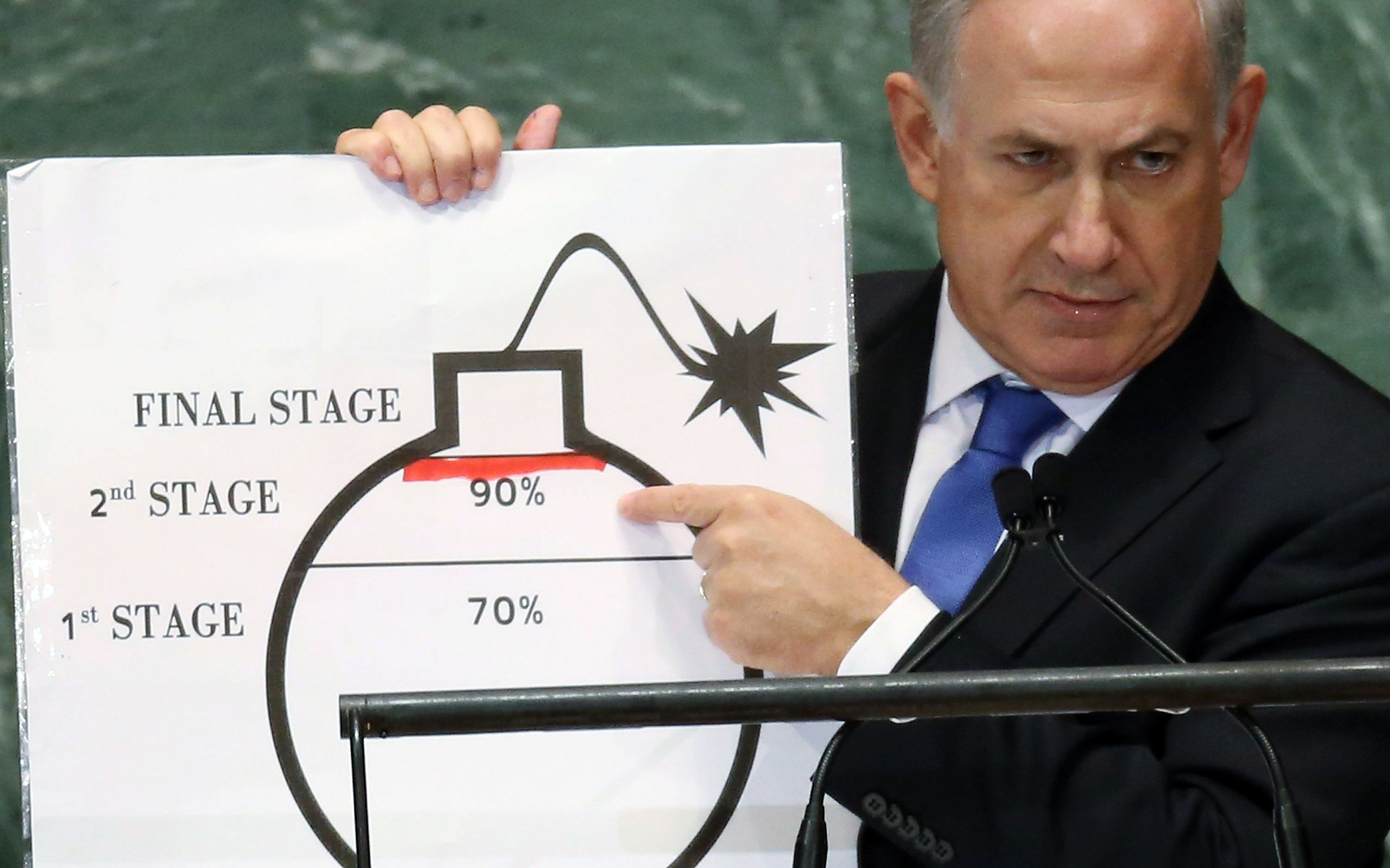
For more than three decades, Israeli Prime Minister Benjamin Netanyahu has delivered a single, unchanging message to the world: Iran is on the brink of acquiring a nuclear weapon, and catastrophe is imminent unless immediate action is taken.
What has changed is not the claim, but the calendar.
From the mid-1990s onward, Netanyahu has repeatedly warned that Iran was only a short time away — sometimes “a few years,” sometimes “months,” sometimes implicitly any day now. Each deadline passed. Each warning expired. And each time, the clock was reset.
This is not a story of one mistaken forecast. It is a pattern — sustained, public, and consequential — in which urgency is asserted, disproven by time, and then reasserted again.
A Pattern of Alarm, Not Prediction
Netanyahu’s claims have not been abstract policy disagreements. They have been used to:
Pressure the United States into confrontation
Undermine diplomatic agreements
Justify sanctions, covert action, and eventually military strikes
Frame Iran as a permanent, existential emergency
Yet despite decades of warnings, Iran has not produced a nuclear weapon.
The question is no longer whether Netanyahu was wrong once.
The question is how many times a leader can be wrong about an “imminent” threat before credibility itself becomes the issue.
Timeline: Three Decades of “Almost There”
1992
As a member of the Knesset, Netanyahu warned that Iran was three to five years away from developing nuclear weapons capability.
This placed the supposed deadline in the mid-1990s.
1995
In his book Fighting Terrorism, Netanyahu escalated the claim, writing that Iran was five to seven years at most from being able to independently produce nuclear weapons.
Even at the outer edge of his own estimate, Iran should have had a bomb by the early 2000s.
1996
As prime minister, Netanyahu addressed U.S. lawmakers and officials, arguing that Iran’s nuclearization was rapidly approaching and required urgent American intervention.
No bomb followed.
2009
More than a decade later, Netanyahu told U.S. congressional delegations that Iran was now one to two years away from assembling a nuclear weapon.
By this logic, Iran should have gone nuclear around 2011.
It did not.
2012
Netanyahu delivered his most infamous warning at the United Nations, holding up a cartoon diagram of a bomb and drawing a red line across it.
He claimed Iran would reach the critical threshold by the following spring or summer.
That deadline came and went — publicly, unmistakably, and without the event he promised.
2015–2020
Even as international inspections and intelligence assessments found no active nuclear weapons program, Netanyahu insisted Iran was merely biding time and that diplomacy was a dangerous illusion.
The “imminent” threat remained — always imminent, never realized.
2024–2025
Netanyahu’s government again asserted that Iran could produce nuclear weapons in a very short time, sometimes described in terms of weeks or months if left unchecked.
This rhetoric was used to justify open military action and to frame escalation as unavoidable.
The Prosecutorial Reality
A prosecutor does not evaluate intent by rhetoric — but by results.
Netanyahu has repeatedly asserted specific timeframes.
Those timeframes have repeatedly failed.
The warnings have been recycled without accountability.
Each failed prediction has been followed by a new, equally urgent one.
This is not intelligence error.
It is narrative persistence.
Netanyahu has treated the claim of Iran’s imminent nuclear weapon not as a hypothesis to be tested, but as a political constant, immune to falsification by time.
Moving the Goalposts, Not the Facts
Over the years, the language has subtly shifted:
From “years away”
To “months away”
To “threshold capability”
To “breakout time”
Each shift narrows the definition just enough to avoid admitting prior claims were wrong — while preserving the sense of emergency.
This rhetorical maneuver allows the warning to survive failure, even as its original meaning collapses.
The Cost of Permanent Alarm
The consequences of this pattern are not academic.
Diplomatic off-ramps were sabotaged
Military escalation was normalized
Public fear was continuously stoked
Skepticism was labeled naïveté
Restraint was framed as weakness
When every year is the final warning year, no warning is ever final.
In The End
For more than 30 years, Benjamin Netanyahu has insisted that Iran was on the verge of acquiring nuclear weapons.
Thirty years later, the bomb he promised has not materialized.
What has materialized is a record — one in which imminence is declared, disproven, and redeclared, again and again, with no reckoning.
At some point, the issue stops being Iran’s timeline and becomes Netanyahu’s credibility.
And on that count, the timeline is no longer on his side.

No comments:
Post a Comment