Showing posts with label Lebanon. Show all posts

Wednesday, June 24, 2026

Political Theater or Peace Diplomacy? The Debate Over America's Role in the Lebanon Conflict


A recent exchange involving Vice President JD Vance and Iranian officials has reignited a debate that has become central to discussions surrounding the conflict in Lebanon and the broader Middle East.

According to Vance, no government on Earth has done more than President Trump and the United States to bring the Lebanon conflict to an end. Supporters of the administration point to diplomatic efforts, negotiations with regional partners, and attempts to prevent a wider regional war as evidence that Washington has been actively pursuing stability.

Critics, however, see the claim very differently.

They argue that the statement ignores a fundamental contradiction at the heart of U.S. policy. While American leaders frequently present themselves as advocates for peace and de-escalation, the United States continues to provide Israel with military aid, weapons, intelligence cooperation, diplomatic protection, and political support.

To critics, that reality makes Washington's peace messaging difficult to accept.

Their argument is straightforward: a nation cannot simultaneously claim to be ending a conflict while continuing to support one of the principal military actors involved in that conflict. Whether one agrees with that assessment or not, it remains a criticism increasingly voiced by governments, human rights organizations, activists, and commentators around the world.

The analogy often used is simple. It is difficult to claim credit for extinguishing a fire while continuing to supply fuel to the flames.

That criticism was echoed in Iran's response. Iranian officials argue that if the United States genuinely seeks peace, it should use its considerable leverage to pressure Israel toward a ceasefire and reduce military support that critics say enables ongoing military operations in Lebanon and Gaza.

Supporters of the American position reject that characterization. They argue that U.S. support for Israel is rooted in longstanding security commitments and that American involvement helps prevent even greater instability. From this perspective, diplomatic engagement and military support are not mutually exclusive and can be used simultaneously to pursue security and eventual peace.

The dispute highlights a larger question that extends beyond Lebanon.

What does it mean to be a peacemaker in a conflict?

Is peace achieved through diplomacy while maintaining alliances and military partnerships? Or does true neutrality require distancing oneself from one side of the conflict altogether?

For critics of current U.S. policy, the answer is clear. Peace is more than speeches, press conferences, and diplomatic talking points. Peace requires actions that reduce violence and address the conditions that allow conflict to continue.

They argue that if the United States wants recognition for helping end the conflict, it must first confront accusations that its own policies contribute to the continuation of that conflict.

Supporters of Washington's approach disagree, insisting that American engagement remains essential to any eventual settlement and that abandoning allies would not bring peace closer.

The debate ultimately reflects a broader struggle over how history will judge America's role in the Middle East: as a mediator seeking stability, or as a participant whose policies helped shape the conflicts it now seeks to resolve.


Friday, June 19, 2026

"All of Lebanon Must Burn": Ben-Gvir Remarks Ignite Debate Over Collective Punishment and International Double Standards


Israeli National Security Minister Itamar Ben-Gvir has come under intense criticism following reports that he declared that "all of Lebanon must burn" after four Israeli soldiers were killed during fighting with Hezbollah in southern Lebanon. According to accounts circulating in Israeli and regional media, Ben-Gvir said, "For every tear of an Israeli mother, a thousand Lebanese mothers must weep," arguing that Israel's security concerns should outweigh diplomatic considerations.

The remarks followed the Israeli military's announcement that four soldiers had been killed in a Hezbollah attack in southern Lebanon, one of the deadliest incidents involving Israeli forces in the current phase of the conflict. The deaths prompted renewed calls from hardline figures within the Israeli government for a broader military response against Hezbollah.

Ben-Gvir, leader of the far-right Jewish Power party, has long advocated more aggressive military policies and has opposed ceasefire proposals. Critics argue that rhetoric directed toward an entire country rather than a specific armed organization raises serious concerns about collective punishment and the treatment of civilians.

Under international humanitarian law, combatants and civilians are treated differently, and the deliberate punishment of civilian populations is prohibited. Children are civilians. Women are civilians. Entire countries are not military targets under international law.

Human rights advocates warn that language aimed at entire populations risks normalizing collective punishment and blurring the distinction between military targets and civilians. They argue that rhetoric portraying all citizens of a country as legitimate targets undermines long-established legal principles governing armed conflict.

The controversy has also renewed accusations of double standards in international politics. Critics ask whether the reaction would be similar if a senior official from Iran, Russia, or China had publicly declared that "all of Israel must burn." Would such comments be described merely as inflammatory rhetoric, or would they dominate international headlines and prompt demands for investigations and condemnation?

Those raising the issue contend that statements by Israeli officials often receive less scrutiny than comparable remarks made by governments viewed as adversaries of Western nations. They argue that international outrage frequently depends not only on the content of the statement but also on who is making it.

The controversy comes amid fears that the fighting between Israel and Hezbollah could escalate into a wider regional war. Months of cross-border exchanges have caused widespread destruction and displaced large numbers of civilians in both Lebanon and northern Israel. Diplomatic efforts involving the United States and regional powers have sought to prevent the conflict from expanding further.

Critics also note that the roots of conflict in Lebanon predate Hezbollah, pointing to decades of war, invasions, occupation, and political interference as factors that contributed to the rise of armed resistance movements. Some cite remarks attributed to Israel's first prime minister, David Ben-Gurion, who reportedly acknowledged that had he been born an Arab, he too might have resisted.

Supporters of Israel maintain that Hezbollah bears responsibility for attacks on Israeli civilians and soldiers and emphasize that the organization is designated as a terrorist group by the United States and several other countries. They argue that Israel has a right to defend itself against Hezbollah's attacks and that criticism should focus on the organization rather than Israel's broader security concerns.

As tensions continue to rise, the controversy surrounding Ben-Gvir's reported remarks has intensified debate over wartime rhetoric, the legality of collective punishment, and whether international standards are applied consistently. The dispute highlights a broader question extending beyond the current conflict: whether civilian lives are valued equally regardless of nationality, and whether identical words spoken by different governments receive the same level of condemnation.

Sunday, May 3, 2026

Faith Under Rubble: Israel's Destruction of Christian Sites in South Lebanon Sparks Global Outcry


The reported demolition of Christian religious sites in southern Lebanon—including the Salvatorian Sisters’ convent and school in Yaroun—has ignited outrage and renewed scrutiny over the broader implications of war on cultural and religious identity. According to accounts circulating in the region, the destruction was carried out by forces operating under the authority of the Israeli government, raising serious ethical and political questions.

Churches, monasteries, and crosses are not merely physical structures. They represent centuries of continuity—anchors of faith for generations who have lived, worshipped, and coexisted in a region long defined by its religious diversity. When such sites are reduced to rubble, the loss is not only architectural. It is symbolic, cultural, and deeply personal.

The involvement of Israel in military operations in southern Lebanon has long been a point of geopolitical tension. However, the reported use of heavy demolition equipment—machinery designed to dismantle structures from a distance—raises concerns about intent and proportionality. The destruction of a convent and school, places associated with refuge, education, and peace, intensifies those concerns.

Critics argue that accountability must extend beyond those physically carrying out the demolition. Attention has turned toward Washington, D.C., where foreign policy decisions and military aid are determined. Allegations that American taxpayer-funded support may indirectly contribute to such actions have prompted calls for greater transparency and oversight.

Political leaders, including figures such as Mike Huckabee, have frequently spoken about protecting Christian communities and religious heritage worldwide. Incidents like this, however, test whether those commitments are consistently upheld when actions involve allied governments.

The perceived lack of a strong response from institutions such as Congress and the White House has fueled frustration among observers who view the destruction of religious sites as a violation of universally recognized cultural and moral norms. If safeguarding sacred spaces is a global principle, critics argue, it must be applied without exception.

South Lebanon has long stood as a symbol of coexistence, where Christian and Muslim communities have lived side by side despite decades of conflict. The destruction of religious landmarks risks not only erasing history but also undermining the fragile social fabric that has endured through generations.

In the end, history will not only examine the actions taken on the ground but also the broader network of responsibility—those who authorized, enabled, or failed to respond. When faith and heritage are caught in the crossfire, the consequences extend far beyond a single moment, leaving lasting scars on both memory and identity.

The real question is when will the world stand up to Israel?

Saturday, April 11, 2026

“Gaza Model” Debate Intensifies as New Security Plans for Southern Lebanon Draw Global Scrutiny


BEIRUT — A controversial new security concept being discussed in connection with southern Lebanon is drawing sharp international attention, with critics warning it could dramatically reshape the region’s landscape — and its legal and humanitarian realities.

At the center of the debate are remarks and reported planning tied to Israel Katz, suggesting an expansion of security measures along Israel’s northern border that some observers have labeled a potential “Gaza model” approach.

A Buffer Zone Strategy

According to analysts and regional observers, the proposal focuses on creating a deep buffer zone inside southern Lebanon, aimed at preventing cross-border attacks from militant groups operating near the frontier.

Such a strategy could include:

  • Widespread demolition of structures in frontline villages

  • Long-term restrictions on civilian return to certain مناطق

  • Sustained military presence extending toward the Litani River

Supporters argue that these measures are designed to eliminate cover for armed groups and reduce the threat of rocket fire into northern Israel.

Displacement Concerns

Humanitarian organizations and regional officials warn that any large-scale clearing operation could lead to significant civilian displacement.

Estimates circulating in policy discussions suggest that hundreds of thousands of Lebanese residents could be prevented from returning to their homes for an extended period if such a plan were implemented.

Critics say that would risk creating a prolonged humanitarian crisis, echoing displacement patterns seen in other conflict zones.

Legal and International Reaction

The proposal is already prompting debate among legal experts and international observers.

Under international humanitarian law — including the Geneva Conventions — the destruction of civilian property and forced displacement of populations are heavily restricted, particularly if not justified by immediate military necessity.

Legal analysts caution that broad, systematic demolition policies could face scrutiny under war crimes statutes, depending on how they are carried out and justified.

At the same time, Israeli officials and security analysts argue that the threat environment along the northern border — particularly involving groups like Hezbollah — necessitates stronger defensive measures.

Regional and Global Implications

The discussion comes amid already heightened tensions across the Middle East, with ongoing conflicts and fragile ceasefire efforts shaping the broader geopolitical landscape.

Any move to establish a long-term military-controlled buffer zone inside Lebanon could:

  • Escalate tensions between Israel and Lebanon

  • Complicate ongoing diplomatic efforts in the region

  • Draw increased involvement or condemnation from international bodies, including the United Nations

A Defining Moment

While no final policy has been formally implemented, the debate itself underscores how security doctrine in the region may be shifting toward more aggressive territorial control measures.

For supporters, the strategy represents a necessary evolution in border defense.
For critics, it raises profound questions about legality, proportionality, and the long-term consequences of reshaping civilian مناطق through military force.

As discussions continue, the stakes extend far beyond the border — touching on international law, regional stability, and the future of civilian populations caught in the middle of conflict.

Image

 Image

Image

Image


Friday, April 10, 2026

Dearborn Michigan Vigil Draws Community Together in Grief, Calls for Ceasefire in Lebanon


DEARBORN, Mich. — Under the soft glow of candlelight, residents gathered at Dearborn Peace Park West on Friday night, forming a quiet but powerful show of unity, grief, and resolve.

The vigil brought together families, friends, and neighbors from across the Dearborn community to honor civilians killed amid ongoing violence in Lebanon. As flames flickered in the evening air, the crowd stood in solemn silence — a moment that spoke louder than words.

Among those present were local dignitaries and community leaders, including Abdullah Hammoud, who has previously spoken out against violence impacting civilians abroad. Several faith leaders also attended, reflecting Dearborn’s diverse religious fabric. While not all were formally identified, attendees included imams from local mosques, priests from Eastern Catholic and Orthodox churches, and interfaith leaders who offered prayers for peace and the protection of innocent lives.

Many attendees described the gathering as both deeply personal and urgently political. For Lebanese Americans in the region, the losses overseas are not distant headlines, but tragedies that strike close to home.

“This is about humanity,” one attendee said. “Every life lost matters. Every civilian deserves protection.”

The urgency behind the gathering is underscored by the scale of the humanitarian toll. According to multiple reports, nearly 2,000 people have been killed in Lebanon during the current escalation, with more than 6,000 others wounded. Earlier phases of the conflict saw over 1,000 deaths in just weeks, and some of the deadliest strikes — particularly in densely populated areas of Beirut — have killed hundreds of civilians in single attacks. While exact figures vary, humanitarian groups and international observers have consistently warned that a significant portion of those killed are civilians, including women and children.


Throughout the evening, speakers and participants called for immediate international attention to the escalating violence. The central message was clear: the loss of innocent life must not be ignored, and global leaders must act to prevent further bloodshed.

Several in attendance directed their appeals toward the Trump Administration, urging swift diplomatic action to secure a ceasefire. The calls reflected a growing frustration among community members who say the humanitarian toll continues to rise without sufficient intervention.

The vigil, however, was not solely about protest. It was also a space for mourning, reflection, and solidarity. Children stood beside parents, friends embraced, and candles were raised in quiet remembrance of those lost.

Dearborn, home to one of the largest Arab American populations in the United States, has long been a focal point for community response during moments of crisis in the Middle East. Friday night’s gathering continued that tradition — blending grief with a call to conscience.


As the vigil came to a close, the message lingered in the air: silence is not an option in the face of suffering. For those gathered, the evening was not just about remembrance — it was a demand for peace, justice, and the protection of innocent lives.


Wednesday, April 8, 2026

Strait of Hormuz Closed Again as Iran Rejects Negotiations; Israeli Strikes Intensify in Lebanon

DUBAI, United Arab Emirates — Iran announced the renewed closure of the strategic Strait of Hormuz on Tuesday, declaring that diplomatic efforts had failed and dismissing U.S. President Donald Trump’s claims of negotiations as illegitimate.

Iranian officials said there had been “no real negotiations,” accusing Trump of “negotiating with himself” while continuing military and political pressure in the region. The closure of the waterway — a critical artery for global oil shipments — marks a sharp escalation in tensions that are already reverberating across international markets and security alliances.

The move comes amid intensifying violence in Lebanon, where Benjamin Netanyahu has not agreed to a ceasefire. Israeli airstrikes have expanded in recent days, with reports of attacks in Beirut, Sidon and areas near Baalbek. Local officials and humanitarian sources report significant civilian casualties, including strikes on densely populated neighborhoods and a funeral procession.

Lebanese authorities said hundreds of civilians have been killed or injured in the latest wave of attacks. The government condemned the strikes as indiscriminate and warned of a worsening humanitarian crisis. There was no immediate detailed response from Israeli officials regarding specific targets, though Israel has previously said its operations are aimed at militant infrastructure.

Iran linked the renewed closure of the Strait of Hormuz directly to the ongoing conflict in Lebanon, arguing that continued military action made de-escalation impossible. Iranian state media described the closure as “permanent” unless broader regional hostilities cease.


The strait, which handles roughly a fifth of the world’s oil supply, has long been a flashpoint in regional tensions. Any sustained disruption is expected to have immediate global economic consequences, including spikes in energy prices and concerns over supply stability.

International reaction has been swift. Several governments called for restraint and urged all parties to return to diplomatic channels, warning that further escalation could trigger a wider regional conflict.

Analysts say the situation reflects a breakdown in coordinated diplomacy, with competing military actions undermining any potential agreements. The absence of a unified ceasefire framework — particularly involving Israel and Lebanon — has complicated efforts to stabilize the region.

As of Tuesday evening, there were no indications that the Strait of Hormuz would reopen or that a ceasefire in Lebanon was imminent.


Monday, April 6, 2026

France Enters The Fray To Support Lebanon From Israel


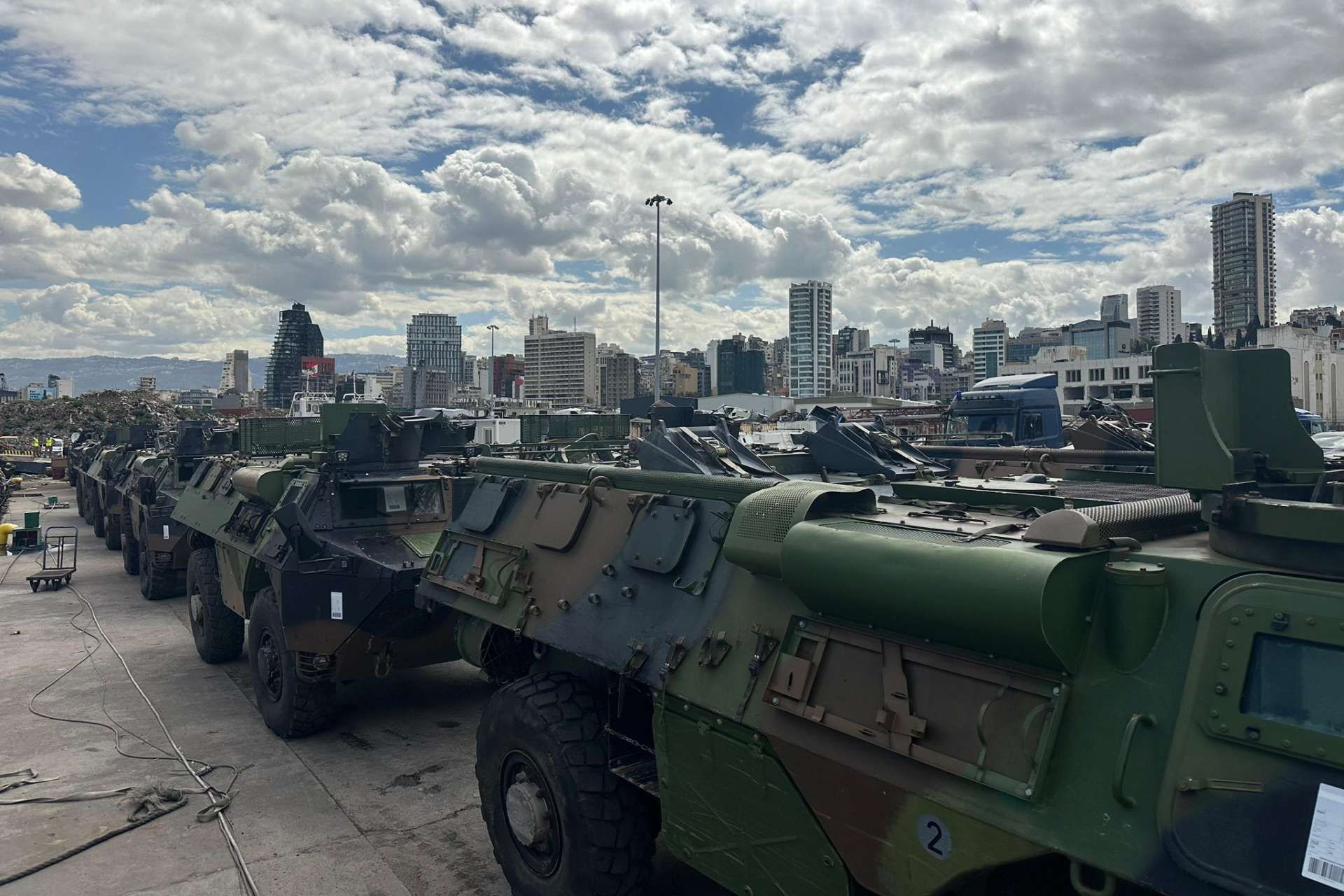
BEIRUT — In a move aimed at stabilizing a nation under pressure, Emmanuel Macron’s government has delivered 39 armored personnel carriers to the Lebanese Armed Forces, reinforcing France’s long-standing commitment to Lebanon’s sovereignty and civilian protection.

The delivery, announced by France’s Defense Ministry and overseen by Deputy Defense Minister Alice Rufo, is being framed not as an act of aggression, but as a necessary step to strengthen a fragile state caught in the crossfire of a widening regional war.

At the port of Beirut, Rufo emphasized the purpose behind the transfer: protecting civilians, preserving state institutions, and defending Lebanon’s territorial integrity — values increasingly under threat as violence escalates along its southern border.


FRANCE REASSERTS A STABILIZING ROLE

Image


The armored vehicles, known as VABs, are designed for troop transport in high-risk environments. Built with reinforced steel and capable of carrying fully equipped soldiers, they provide the Lebanese army with critical mobility and protection in areas facing repeated airstrikes and ground incursions.

France’s support signals more than a military transaction. It reflects a broader geopolitical stance: that Lebanon must not be allowed to collapse under external pressure or be reduced to a battlefield for larger powers.

For decades, Paris has maintained historical, political, and cultural ties with Beirut. This latest move reinforces France’s position as one of the few Western powers actively working to bolster Lebanese state authority rather than undermine it.


ISRAEL’S MILITARY CAMPAIGN FUELS INSTABILITY

At the heart of the crisis is Israel’s ongoing military campaign in southern Lebanon, launched following cross-border tensions involving Hezbollah. Since early March, Israeli airstrikes and ground operations have intensified, leaving widespread destruction and civilian casualties in their wake.

Rather than containing the situation, the escalation has deepened instability — stretching Lebanon’s already fragile infrastructure and pushing the region closer to a broader conflict.

Critics argue that Israel’s actions go far beyond defensive measures, instead contributing to a cycle of violence that endangers civilians and erodes any remaining prospects for regional de-escalation.


LEBANON CAUGHT IN A REGIONAL FIRESTORM

Lebanon now finds itself trapped between multiple fronts. The conflict expanded dramatically after a joint U.S.-Israeli offensive against Iran triggered retaliatory strikes across the region, including attacks targeting Israel and U.S. military positions.

This widening war has turned Lebanon into a pressure point — a nation struggling to maintain sovereignty while absorbing the fallout of decisions made far beyond its borders.

In this context, France’s support is being viewed by many as a lifeline — a means of empowering Lebanon’s national army to assert control, protect civilians, and resist being pulled deeper into a devastating regional war.


A TEST OF INTERNATIONAL PRIORITIES

France’s delivery of armored vehicles underscores a growing divide in international approaches to the crisis. While some actors escalate military operations, others are attempting to reinforce state institutions and prevent total collapse.

The question now is whether efforts like France’s will be enough.

For Lebanon, the stakes could not be higher. Without meaningful international support aimed at stability — not escalation — the country risks becoming yet another casualty of a conflict that continues to spiral outward.

As the region watches closely, one reality is becoming clear: the path to security will not be paved by airstrikes and offensives, but by strengthening nations under siege and prioritizing the protection of civilian life.