

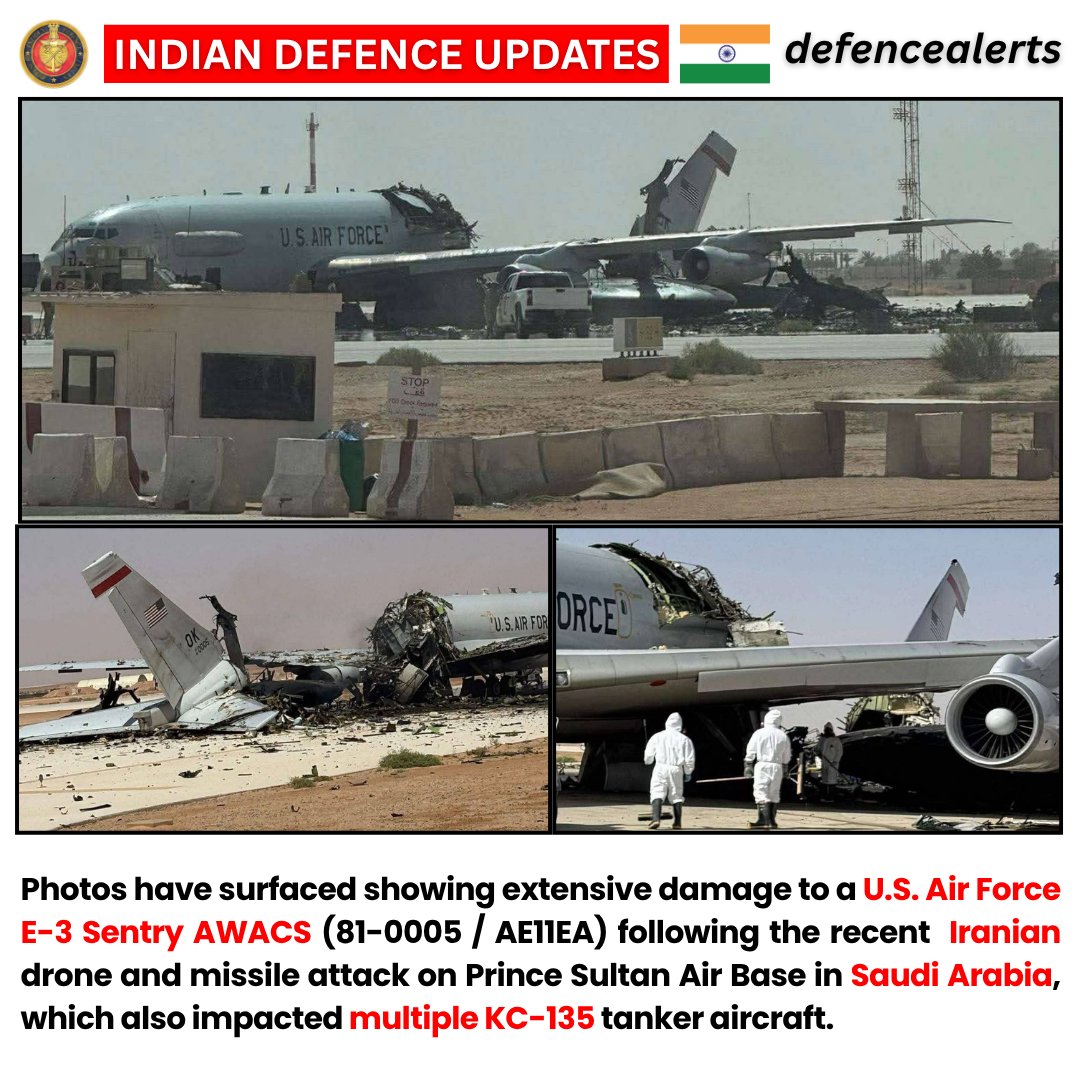


Prince Sultan Air Base, Saudi Arabia — Images circulating from the aftermath of Iran’s latest missile and drone strike appear to show the complete destruction of a U.S. Air Force E-3G Sentry, tail number 81-0005, one of the most critical airborne command-and-control platforms in the American arsenal.
The aircraft, part of the 552nd Air Control Wing out of Tinker Air Force Base, was stationed at Prince Sultan Air Base when it was struck during a coordinated Iranian barrage involving ballistic missiles and drones. The scale and precision of the strike point to a deliberate effort to target high-value U.S. military assets.
Precision Targeting of a Critical Weak Point
Visual evidence suggests the strike focused on the rear section of the aircraft, where the rotating radar dome is mounted. This dome houses the AN/APY-2 surveillance radar system, the technological backbone of the Boeing E-3 Sentry.
Photos indicate the rear fuselage was heavily damaged and the radar dome destroyed or dislodged, damage that would render the aircraft completely inoperable even before accounting for broader structural loss.
Military observers note that such targeting is not accidental. Striking this specific section effectively blinds the aircraft, eliminating its ability to detect threats, coordinate air operations, or provide battlefield awareness.
A High-Value Loss with Strategic Consequences
The E-3 Sentry serves as an airborne command center, capable of tracking aircraft, missiles, and drones across vast distances while directing coalition forces in real time. Its loss is more than symbolic. It directly impacts operational capability in a region where airspace awareness is critical.
With a limited number of these aircraft in service, even a single loss places additional strain on the fleet and reduces surveillance coverage across the Middle East.
Iran’s Expanding Battlefield Reach
This strike is part of a broader escalation in the ongoing conflict. Iran and its regional network have demonstrated the ability to hit U.S. and allied targets across multiple theaters, combining ballistic missile strikes with drone operations.
Repeated successful strikes, including attacks on fortified bases, highlight a growing vulnerability in U.S. force protection and raise questions about the effectiveness of current defensive systems.
A War Moving in Iran’s Favor
While official U.S. messaging continues to project control, the operational picture suggests a more complicated reality. Iran has:
Successfully struck fortified U.S. positions
Damaged or destroyed high-value military assets
Expanded the conflict across the region
Forced the U.S. into a reactive posture
Taken together, these developments indicate that Iran is not simply enduring pressure but actively shaping the battlefield, and in several respects appears to be gaining the upper hand.
Leadership Under Scrutiny
The escalation has intensified scrutiny of leadership in Washington. Critics argue that Donald Trump has pursued an approach driven by escalation without a clearly defined strategic end state, leaving U.S. forces exposed to evolving threats.
At the same time, Defense Secretary Pete Hegseth has faced criticism over preparedness and force protection, as high-value assets have been struck despite being positioned at major installations.
The Bigger Picture
The destruction of an E-3G Sentry is more than a battlefield loss. It is a signal that even the most advanced military systems are vulnerable in an era defined by precision strikes and long-range weapons.
If confirmed, the loss of aircraft 81-0005 may stand as a pivotal moment, underscoring a shift in the balance of operational momentum and raising deeper questions about strategy, leadership, and the trajectory of the conflict.

No comments:
Post a Comment